Showing posts with label Quantum Mechanics. Show all posts

Saturday, 31 December 2011

Teleportation

             Ever since the invention of wheel more than 5000 years ago, human desire to reach a place faster has lead to numerous inventions. From chariot to bicycle to automobile to airplane and rocket, all have been created with a single motive to travel faster. But all these inventions share the same flaw; it requires us to travel the physical distance. With development in the field of paranormal physics, scientists have been trying to combine the properties of telecommunication and transportation to achieve “teleportation”.
         Teleportation involves transfer of matter from one place to another without physical traversing the space between them. It deals with dematerializing an object at one point, sending the details of the precise atomic configuration at another location where it will be reconstructed. With the tremendous potential being embedded on this invention it would explore the possibilities of travelling without physically crossing the space. The idea of teleportation moved out of the realm of science fiction into the world of theoretical possibility in 1933. Physicist Charles Bennett with a team of researchers at IBM confirmed that quantum teleportation is possible, but only if the object being transported was destroyed. Since then, experiments using photons has proven that quantum teleportation is in fact possible.
          In 1998, physicists at Caltech successfully teleported a photon by reading its exact atomic structure, sending the information across 1 meter of coaxial cable and creating a replica of photon.  As predicted, the original photon was destroyed once the replica was made. In the event of teleporting objects larger than photon the main hurdle in the path is “Heisenberg Uncertainty Principle”. The principle states that determining the momentum and location of a particle simultaneously is not possible. If you cannot determine the location of a particle then how can you teleport it? The photon experiment was carried out by using a phenomenon called entanglementFor a person to be transported, a machine would have to be built that can pinpoint and analyze all of the  atoms that make up the human body. That's more than a trillion trillion atoms. The machine would then have to send this information to another location, where the person's body would be reconstructed with exact precision. Molecules couldn't be even a millimeter out of place, lest the person arrive with some severe neurological or physiological defect. The laws of physics may even make it impossible to create a transporter that enables a person to be sent instantaneously to another location, which would require travel at the speed of light. The availability of this technology tough looks bleak in the near future.
           But like all technologies, scientists are sure to continue to improve upon the ideas of teleportation to the point that we may one day be able to avoid such harsh methods. One day, one of your descendants could finish up a work day at a space office above some far away planet in a galaxy many light years from Earth, tell his or her wristwatch that it's time to beam home for dinner on planet X below and sit down at the dinner table as soon as the words leave his mouth.


By: Ankit Jain

Friday, 18 March 2011

Heisenberg Uncertainty Principle

 
   Diving into the world of sub atomic particles we come across the most important concept of the "Uncertainty" introduced by WERNER HEISENBERG, one of the founders of the "Quantum Mechanics" in the year 1927. He proposed that the exact position and the velocity of  an object cannot be known simultaneously. The equation describes a relation between the position and velocity/momentum of a microscopic body such as an electron.

        
   Heisenberg said that when the precision of measuring one quantity increases then, the precision of measuring the other quantity decreases. Consequently it can be seen that if we try to measure the position of an electron then we cannot precisely find its velocity. It is because of the fact that to make any measurement we need to see the particle for which we need light, that is a quanta (photon) is required to be aimed at the specimen particle. When the photon hits the particle then it bounces the particle out of its orbit hence changing its position/location. One may argue that we may someday overcome this problem with advanced technology in measuring instruments. But it may be here emphasised that the limitation of uncertainty is not due to the limitation of the present day technology, rather a limitation in nature as we need light (photon) to see. It seems as if nature itself has limited us with the power and conceals some of its secrets.

Friday, 18 February 2011

Schrödinger's Cat


INTRODUCTION
Erwin Schrödinger
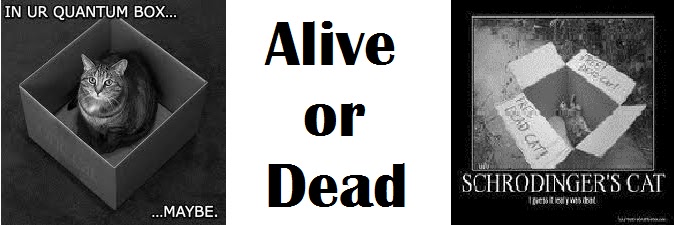
Schrödinger's Cat is a thought experiment which was devised by the Austrian physicist ERWIN SCHRÖDINGER in 1935. The thought experiment presents a cat that might be alive or dead, depending on an earlier random event.


PURPOSE
The above experiment illustrates the problem of the Copenhagen Interpretation of quantum mechanics when applied to everyday objects.


CONSTRUCTION
A cat along with a flask filled with a poison and a radioactive source is placed in a sealed box. A Geiger Counter is placed inside the box to detect radiation. The flask shatters when the radiation is detected. Due to the breaking of flask the poison is released in the box thereby killing the cat. Standing with Copenhagen Interpretation of the quantum mechanics implies that after a while, the cat is simultaneously alive & dead, contradicting the common experience.


EXPLANATION

Superposition of
two states


In common observation, a person defines or describes only one state of a system which is well-defined by a wave function associated with the system. As an example imagine a tree in a forest. Whether the tree in forest is standing or has fallen, either of two can be associated but not both. At particular instant of time, a system has only one state.


In Copenhagen Interpretation of quantum mechanics, a system stops being a superposition of two states and becomes either of two when an observation is made. This clearly shows that the wave function collapses to a single value whenever a conscious observation is made. Copenhagen Interpretation is an observer induced collapse.
When the cat is sealed inside the box, it is alive. Now after a while, there are two states that can be associated to the system(containing cat & flask)-"decayed nucleus/dead cat" or "undecayed nucleus/alive cat". The decay of the radioactive substance is small, may be one atom per hour. Now, when the box is opened, i.e. an observation is made, so the wave function of two states for a single system collapses into one state. If the atom has not decayed, then the cat is alive and if the atom has decayed, the cat is dead.
Collapse of the Wave Function